The Social Research Association is proud to co-host the annual Cathie Marsh Memorial Lecture, an esteemed event honouring the legacy of Cathie Marsh—an influential social researcher, statistician, and exceptional social survey analyst.
This annual event is co-hosted with the Royal Statistical Society and is a key gathering for social researchers, statisticians, policymakers, and advisors, drawing a wide audience from across the sector.
We would also like to say a special thank you to the Cathie Marsh Institute for their support in the hosting of this year's event.
Registration is now open and spaces are limited so registration is essential. Full venue details will be sent to all registrants ahead of the event.
Generative-AI in Qualitative Research: Step-Change, Abomination, or…?
The use of Generative-AI tools based on the capabilities of Large Language Models (LLMs) is infiltrating every aspect of the qualitative research cycle, from generating ideas to inform design, through data collection, creation and transcription, all phases of data analysis, and writing about and communicating findings. What this means for the professions is yet to be fully understood. Some hail the new era with enthusiasm, advocating for the adoption of these technologies to speed-up and improve qualitative research. Others entirely dismiss its use on ethical and/or methodological grounds. Neither extreme offers a perfect response for all situations. In this lecture we pose a number of important questions that the qualitative community of practice are grappling with, the answers of which will shape the development of guidelines for harnessing Gen-AI for qualitative analysis in different contexts. These include: When might the use of Gen-AI for qualitative research be appropriate, and when is it absolutely not? Is the answer different according to topic focus, data type, analytic method? How do contextual factors like sector, discipline and geographies influence the debate? Why do qualitative researchers consider using Gen-AI in the first place? What problem are they seeking to solve? What affect does the use of Gen-AI have on the legitimacy and reputation of qualitative research? Researchers consider such questions for each qualitative project, yet the community of practice also needs to collectively discuss and address them, and this lecture is part of that process.
Christina Silver, PhD., SFHEA., FAcSS., is Associate Professor (Teaching) in the Department of Sociology at the University of Surrey where she is also Director of the CAQDAS Networking Project (CNP) and Co-Director of the Short Courses in Social Research Methods programme. Since 1998 Christina has been raising awareness about, building capacity in, and training researchers to use, digital tools for qualitative analysis in methodologically appropriate ways. She has trained many thousands of researchers and students around the world. Christina’s passion - and specialism - is in the relationship between methods, technologies and instructional designs. Underlying her approach is ongoing research into how qualitative researchers engage with and adopt technologies, which informs her ever-evolving pedagogy. Since November 2022 when OpenAI launched ChatGPT Christina has been engaging with the genres of new technologies emerging and their impact on the practice and perception of qualitative analysis in different sectors (including academic, government, industry, voluntary, and global, settings). She has conducted dozens of workshops, webinars and other events on the implication of the rise of Generative-AI tools on qualitative analysis and advised and trained international research centres, projects, agencies, individuals, and government departments on the issues. Christina is also Co-Founder and Director of Qualitative Data Analysis Services (QDAS) Ltd.
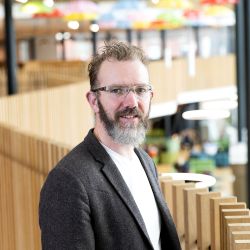
Dr Steven Wright is an independent CAQDAS consultant and accredited trainer for ATLAS.ti, NVivo, MAXQDA and Quirkos. His core interests are in methods development and translation into effective and innovative use of software tools and teaching and supporting these for researchers. He is the author of a series of datasets for SAGE Research Methods exploring new developments in CAQDAS packages including working with auto-transcription, machine-learning content analysis and systematic reviews as well as developing guidance for working with phenomenological approaches. He worked as a qualitative research consultant and learning technologist at Lancaster University for 18 years, and is now Senior Lecturer in Medical Education at the University of Central Lancashire.

Co-hosted by: