Commissioned by
NHS England and administered by
Picker, U16 CPES was developed in 2020 and has since run annually. It was developed following a rigorous process informed by qualitative research with children and their families and by engaging with an Advisory Group of expert stakeholders.
The survey covers the full care pathway, including:
- Finding out about the cancer
- Information and communication
- Involvement in decisions
- Help and support
- Care in hospital e.g. entertainment, Wi-Fi, food, facilities for parents
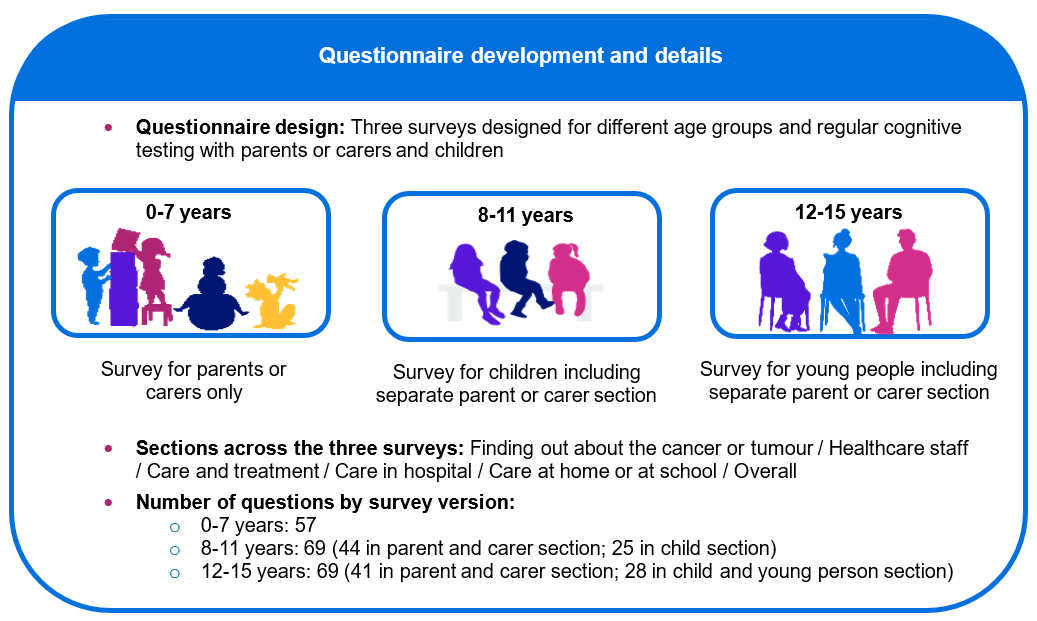
The surveys and the survey website had input from a professional designer and from children and parents or carers, and include colour and imagery appealing to a younger audience to maximise engagement. To accommodate different age groups, three survey versions were developed as seen in the visual below. The surveys are subject to regular cognitive testing to ensure the questions are interpreted as intended, to maximise the reliability of the resulting data.
The results support NHS trusts to improve patient experience locally, while giving NHS England and charity representatives a national view of overall experience of care and variations in care quality. The NHS Cancer Programme uses the survey results and other insight and feedback to inform the focus of the Cancer Experience of Care Improvement Collaborative (CIC), a coaching and quality improvement framework
Survey Overview
Survey methodology
Each year, 13 NHS PTCs provide Picker with a sample of eligible patients under the age of 16 who have a confirmed diagnosis of cancer or a non-malignant tumour and were discharged from hospital in the previous calendar year.
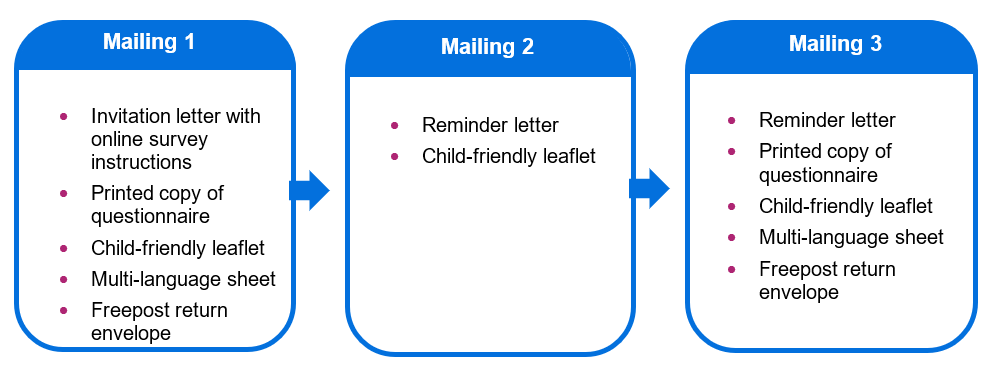
The survey is posted by Picker to the parent or carer of each patient, along with a freepost return envelope and an invitation letter which includes details of how to complete the survey online or via a freephone helpline if preferred. During fieldwork, a communications toolkit, which includes easy read information and materials for posting on social media and in hospitals, is shared with PTCs to support promotion of the survey. Fieldwork runs over 11 weeks between April and June, with up to two reminder mailings sent to non-responders. The contents of the mailing packs are outlined below.
Survey mailing packs
Ongoing oversight of the survey methodology is supported by an Advisory Group, which brings together patient representatives and other stakeholders such as care providers and charities to ensure the survey remains relevant.
More details about the survey methodology, along with a copy of the questionnaires, can be found on the survey website.
Key results from U16 CPES 2024
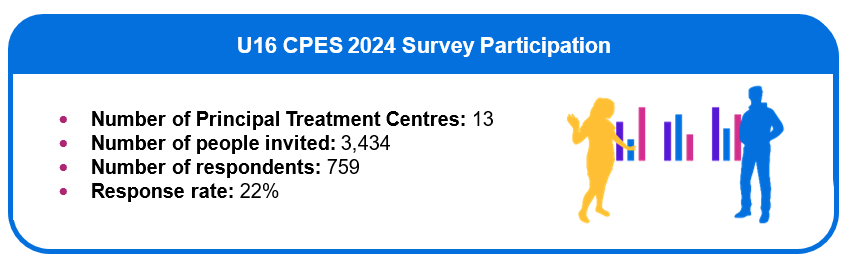
The most recent U16 CPES results were published in November 2025, showing data on children’s cancer care experiences during the calendar year of 2024. A total of 3,434 people across 13 PTCs were invited to take part, and 759 responded, yielding a response rate of 22%. The response rate has declined year-on-year and there may be various reasons for this – including overlap in patients receiving a survey across the survey years, and more generally, changes in public attitudes to surveys. Enhancing response rates continues to be a key focus for our survey efforts.
The survey results are presented in detailed reports and an interactive dashboard. You can also watch the recording of the results webinar, where the national quantitative and qualitative results were presented. These results enable care experiences to be monitored over time and give an indication as to how care is experienced by different groups (such as people of different ages, ethnic backgrounds, and diagnostic groups).
U16 CPES 2024 Survey Participation
Quantitative result
Children and their parents or carers were asked about their overall experience of NHS cancer care.
- 78% of children aged 8-15 reported that they were looked after very well for their cancer or tumour by healthcare staff.
- 91% of parents and carers rated the overall experience of their child's care as 8 or more out of 10.
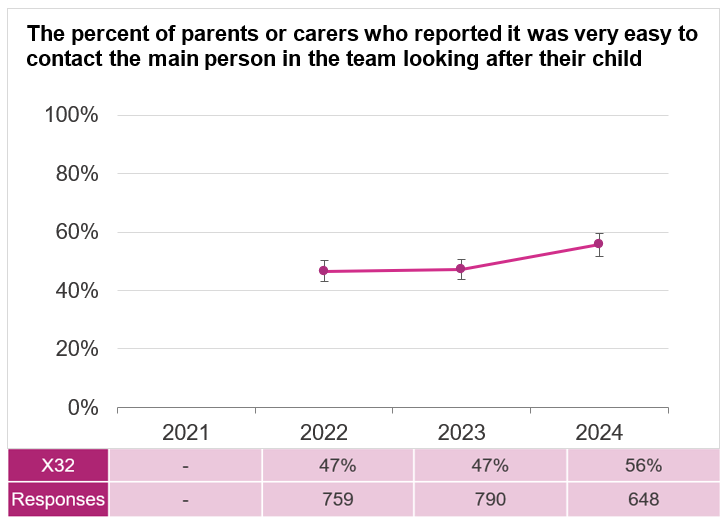
The U16 CPES 2024 results indicated that some aspects of children’s cancer care experiences have changed over time. For instance, 56% of parents or carers in 2024 reported that it was very easy to contact the main person in the team looking after their child, which has increased from 47% in 2023 and 2022.
In 2024, 80% of parents or carers said that staff definitely offered them support to help manage their child's treatment side effects, an improvement from 71% in 2023.
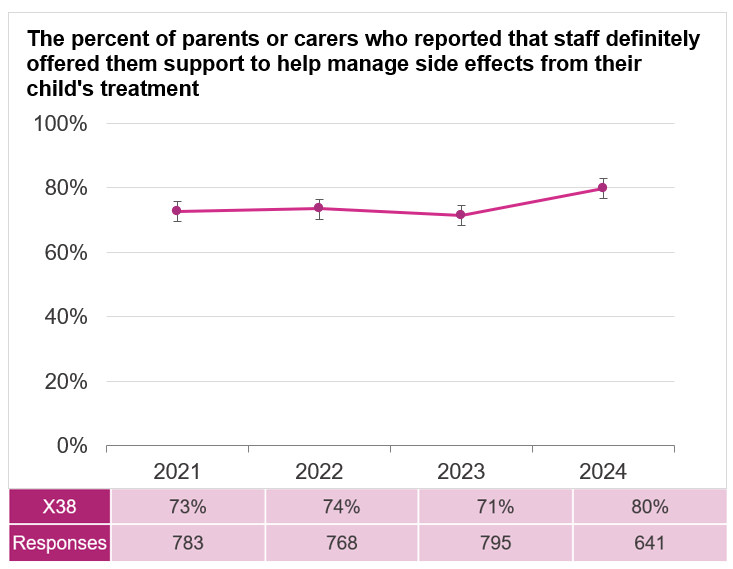
There were no notable decreases in scores between 2024 and 2023.
Experiences that parents, carers and children rated most favourably
Parents, carers, and children rated some experiences more favourably, for example questions relating to how staff treated them and interacted with them, as well as giving them information of people to talk to about the cancer or tumour and overall experience of care. These questions all scored over 90%:
- 97% of parents and carers of 0-11s and children aged 12-15 reported that staff provided details about who to contact for more information after being told about the cancer or tumour.
- 94% of parents and carers of 0-7s and children aged 8-15 felt that the nurses who came to their home or school were always friendly.
- 91% of parents and carers felt that they and their child were always treated with respect and dignity by staff.
- 91% of parents and carers rated the overall experience of their child's care as 8 or more out of 10.
Experiences that parents, carers and children rated least favourably
Parents, carers, and children were asked about their experience of staying in hospital. The following questions scored below 50%.
- 26% of parents and carers of 0-7s and children aged 8-15 reported that it was always quiet enough to sleep in hospital.
- 35% of parents and carers reported that facilities for them to stay overnight were very good.
- 40% of parents, carers, and children felt that there was definitely a suitable choice of hospital food.
- 42% of parents and carers felt that the hospital Wi-Fi always met the needs of them and their child.
- 42% of parents and carers were definitely able to prepare food in the hospital if they wanted to.
- 43% of parents, carers, and children reported that the same nurses always came to their home or school.
Qualitative results
Written feedback could be shared at the end of the questionnaire via two open questions: A) ‘Was there anything particularly good?’, B) ‘Was there anything that could be improved on?’. A sample of comments were thematically analysed, which included all written feedback from children and young people and a selection of parents or carers across different age ranges, questions, and PTCs.
Seven key themes were identified from thematic analysis:
- Staff
- Communication
- Access to care
- Personalised care
- Hospital food
- Things to do in hospital
- Hospital environment
Within each key theme there were several sub-themes which support interpretation and use of the insights.
What next?
The questionnaires and survey materials are currently being cognitively tested in preparation for next year’s iteration of the survey. The 2025 U16 CPES will provide 5 years of comparable data, from 2021 to 2025.
Author Bios:
Amy is Head of Research at Picker. She has over fifteen years of experience in healthcare research and has developed many patient experience surveys for children and their families. She played a fundamental role in the development of the Under 16 Cancer Patient Experience Survey and has also developed children’s inpatient, outpatient, urgent care, allergy and sickle cell disease surveys.
Bernardine is a Research Associate at Picker. She has supported the design, delivery and analysis of a range of patient experience surveys including the National Cancer Patient Experience Survey and the Under 16 Cancer Patient Experience Survey. She is currently working on a project to develop and implement a patient experience survey for people living with Marfan syndrome and Loeys Dietz syndrome.
Sharon is an Insight Support Manager at NHS England. She currently works on delivery of the Under 16 Cancer Patient Experience Survey and the National Cancer Patient Experience Survey. She also supports the development of high-quality surveys across NHS England by advising on questionnaire design and promoting survey best practice.
Acknowledgements
Thank you to all patients and parents or carers who took part in the survey and shared their experiences of care. We also thank the Advisory Group members for providing guidance and support to continuously inform the survey methodology.