Purpose and background of the survey
Commissioned by NHS England and currently administered by Picker, NCPES was developed in response to the Department of Health’s 2007 Cancer Reform Strategy and first ran in 2010. It has since become a key part of the cancer data landscape, helping to improve services by providing insight into patient experience across the cancer pathway.
Oversight of the survey is supported by the NCPES Advisory Group, which brings together patient representatives and other stakeholders including providers and cancer charities to help ensure the survey remains relevant.
The survey supports NHS trusts, Integrated Care Boards, and Cancer Alliances to improve patient experience locally, while giving NHS England a national view of overall experience of care and also where there are variations in care quality.
NCPES survey results have informed the focus of NHS England’s Cancer Improvement Collaboratives (CIC), first launched in 2019 and building on work from the Institute for Healthcare Improvement in America. The CIC provides a quality improvement framework that’s used by groups of cancer healthcare professionals, people with lived experience, and other stakeholders to make improvements in cancer experience of care. Data to inform priorities and assess impact is key. To date, 87 Project Teams have taken part with Teams reporting improvements in patient experience, staff experience and team working. Many have also been able to describe a cultural shift in the way they work together with people with lived experience, leaving a lasting legacy. NHS England’s core team for the CIC work closely with the Cancer Alliance Experience and Engagement Leads who are a key support for Project Teams and a driver for improvements in experience across the Alliance work programme.
Survey methodology
NCPES is an annual survey. Each year, NHS trusts compile a sample of eligible patients based on the following criteria: all adult patients (aged 16 and over), with a primary diagnosis of cancer, who have been admitted to hospital as inpatients for cancer related treatment, or who were seen as day case patients for cancer related treatment, and have been discharged between 1st April and 30th June of the survey year.
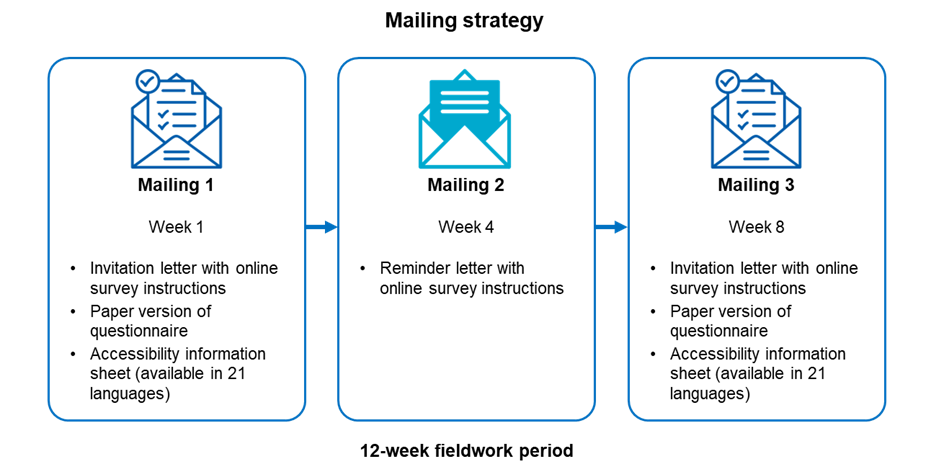
The survey is delivered using a mixed-mode approach over a 12 week fieldwork period, with three mailings sent to participants, as outlined in the diagram below.
The questionnaire covers different aspects of the cancer journey, from diagnosis and treatment to living with and beyond cancer. Across the pathway, NCPES provides data on information provision, involvement and support, supporting our understanding of patient agency. The questionnaire is cognitively tested each year to ensure questions remain clear, relevant, and easy to understand.
To support uptake and accessibility, the 2024 questionnaire was translated into Bengali, Punjabi and Polish for the first time. These were chosen based on their prevalence in England and to better reach underrepresented groups. The translated questionnaires are provided alongside other accessibility options, such as large print and Braille (available on request), as well as a Freephone helpline to support patients with queries and completing the survey in different languages.
A recently redeveloped communications toolkit, which includes materials such as social media cards, posters, and easy read information about the survey, is available to support promotion and raise awareness of the survey among eligible patients.
More details about the methodology are available on the survey instructions page of the NCPES website.
Key results from NCPES 2024
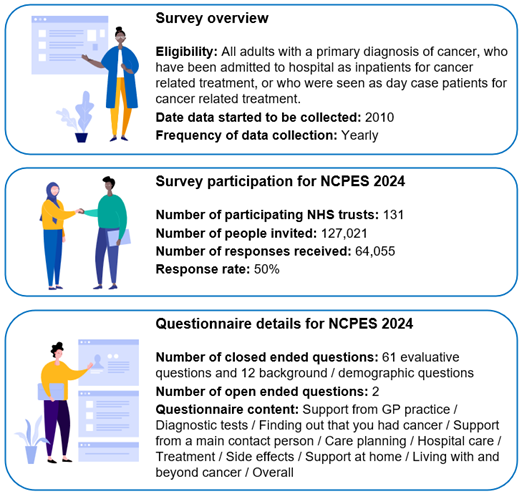
In 2024, the survey involved 131 NHS trusts across England. A total of 127,021 people were invited to take part, and 64,055 responded, yielding a response rate of 50%.
The survey produces detailed reports (including an interactive dashboard). The quantitative results enable users to compare results across years, highlight how care is being experienced by different groups (such as people of different ages, ethnic backgrounds, and tumour groups), and compare results between organisations.
Participants can also leave open-ended comments about their experiences, including what they found positive and what could be improved. These comments are analysed, with individual workbooks of categorised comments provided to trusts and Cancer Alliances, alongside a national thematic analysis to support reflection and learning.
Results from NCPES 2024 show a trend of improvement and stability across most areas of patient experience of cancer care. Between 2023 and 2024, out of the 61 evaluative survey questions, most have improved (30 questions) or remained stable (30 questions), with only one question showing a decrease.
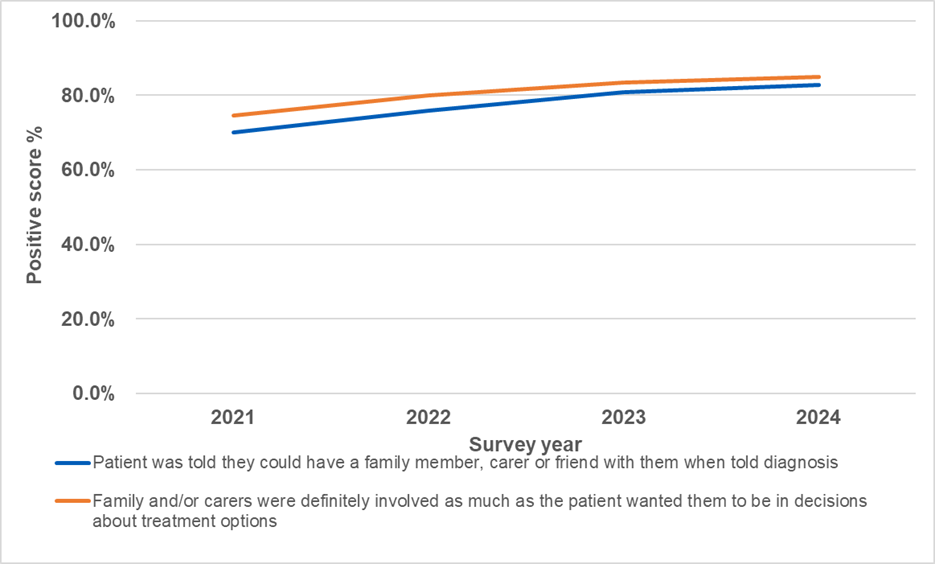
For example, this includes a positive trend in how cancer services are involving family members and carers in patients’ care. 82.7% of patients said they were told they could have a family member, carer or friend with them when receiving their diagnosis. This is up from 80.9% in 2023 and 70.1% in 2021. Similarly, 84.9% felt their family or carers were definitely involved as much as the patient wanted in treatment decisions, up from 83.5% in 2023 and 74.7% in 2021.
It is also reassuring to see that 91.5% had a main contact person within the team looking after them who would support them through treatment. Of these respondents, 95.7% found the advice they received from their main contact person to be very or quite helpful.
Support in primary care and the community is an area for improvement but with positive trends seen. In 2024 only 33.5% said they could definitely get enough emotional support at home from community or voluntary services, though this is an increase from 32.3% in 2023. Similarly, of those that said their GP practice was involved in their cancer treatment, 47.7% said they definitely received the right amount of support from their GP practice during treatment, an increase from 46.4% in 2023.
Future developments
While NCPES currently achieves a 50% response rate, high in comparison to other patient experience surveys, we are taking steps to further reduce non-response bias and enhance the survey’s accessibility. In 2025, a pilot will run alongside NCPES to test a revised mixed-mode methodology. Key changes include:
- Increasing the number of contact points from three to up to six
- The additional contact points will be SMS reminders with links to the online survey (mobile numbers are not currently used in NCPES)
- Replacing the initial paper questionnaire with a push-to-web letter for the first contact
The pilot will be evaluated to assess its effectiveness, with findings used to inform the approach for NCPES 2026.
If you would like to get in touch with the NCPES team, please contact [email protected].
AUTHOR BIOS: Jenny is Chief Research Officer at Picker with over seventeen years of experience in healthcare research, specialising in person centred care and the effective use of feedback to drive quality improvement. She leads a multidisciplinary team of researchers advancing strategy and policy to enhance patient and staff experience.
Joanna is an Insight Support Manager at NHS England. She has worked on both qualitative and quantitative projects with a specialist focus on patient experience surveys. She is currently managing the National Cancer Patient Experience Survey.
ACKNOWLEDGEMENTS
Thank you to all patients who took part in the survey and shared their experience of care. We would also like to thank staff across the NHS – the high overall rating of care is a testament to them.